
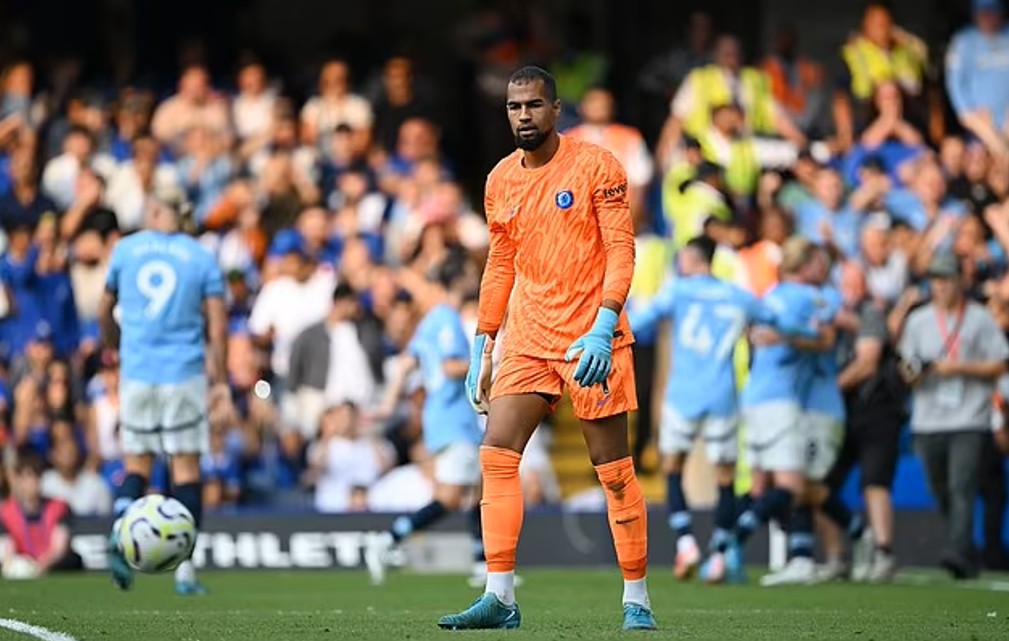
Chelsea’s 3-1 defeat to Manchester City at the Etihad in January 2025/26 turned on two moments that will be attached to Robert Sánchez’s name for a long time. Chelsea led early and were competitive for long spells, but their goalkeeper’s misjudgements for City’s equaliser and Erling Haaland’s go-ahead goal transformed a promising performance into another night that amplified questions about his reliability.
The match context that magnified Sánchez’s mistakes
Understanding why these errors drew so much scrutiny requires looking at the wider context around both Chelsea and Sánchez. Chelsea arrived at the Etihad in need of a statement result, having won only once in their previous six league games and still trying to stabilise under Enzo Maresca. Sánchez, meanwhile, already carried a reputation for high-profile mistakes: by early 2025, he had committed more errors leading directly to goals than any other Premier League player, with five such errors on record. When a goalkeeper with that profile makes fresh mistakes against the champions, in a game where Chelsea initially looked strong, the perception is not of isolated lapses but of a recurring pattern that could undermine an entire project.
Error 1: the Gvardiol equaliser – miscommunication and indecision
City’s first goal, scored by Joško Gvardiol to make it 1-1, came from what should have been a manageable situation for Chelsea’s defence and goalkeeper. Reporting and analysis note that Marc Cucurella and Sánchez “bungled what should have been an easy ball to deal with,” failing to clear effectively and allowing the Croatian defender to pounce. In practical terms, this error combined poor communication (who takes responsibility for the loose ball) with hesitant technique: Sánchez did not decisively claim, punch or stay set on his line, leaving space and time for Gvardiol to shape and finish.
The cause–outcome–impact chain here is straightforward:
- Cause: hesitation and unclear ownership between Sánchez and his defender as the ball dropped in a dangerous zone.
- Outcome: a failed clearance and a second ball falling to Gvardiol in the area.
- Impact: City equalised before half-time, erasing Chelsea’s early lead and shifting momentum in a match where the visitors had previously grown in confidence.
Error 2: charging out for Haaland’s lob – a decision-making breakdown
The second, and more memorable, mistake was Sánchez’s role in Haaland’s 2-1 goal, which City fans and pundits quickly labelled a “howler.” The sequence began with a long ball that Trevoh Chalobah struggled to handle, allowing Haaland to gain control and advance toward goal. At that moment Sánchez moved aggressively off his line, but then hesitated in his choice between retreating to his goal or fully committing to smothering the danger, ending up in a no-man’s-land that invited the chip.
Analysts repeatedly highlight three linked problems in that moment:
- Poor starting position: Sánchez was already advanced enough that he had limited margin for error once Haaland took possession.
- Slow, indecisive adjustment: instead of quickly choosing to drop back or fully close down, he “was caught in two minds,” doing neither effectively.
- Predictable exposure: with a forward of Haaland’s quality, showing that much space and a static body shape made the lob a high-percentage option.
The impact went beyond a single goal. Haaland’s strike turned a tight contest into a City lead that matched the psychological flow of the game: from Chelsea believing they could take something, to seeing their keeper’s decision undo that belief in an instant.
Distribution and composure: the hidden layer of risk
While the headline errors were tied to Gvardiol’s equaliser and Haaland’s lob, underlying distribution problems contributed to the broader sense that Sánchez was destabilising Chelsea’s defensive platform. Detailed analysis points out that in this game his passing accuracy was only about 53.8%, and he lost possession 19 times, with several poor kicks handing City cheap territory and second-phase attacks. City even adapted at times by allowing him to have the ball, trusting that his longer distributions or ambitious switches would eventually go astray and feed their press.
From a structural perspective, this matters because:
- It prevents Chelsea from using the goalkeeper as a safe reset point under pressure, which is central to Maresca’s possession-first approach.
- It forces defenders to defend more waves than necessary, as turnovers invite City to attack again without having to build from deep.
- It increases anxiety in the back line; when defenders are unsure about the quality of passes coming from behind them, they tend to make more conservative or rushed choices.
How City exploited Sánchez’s tendencies
Manchester City’s game intelligence meant they did not treat Sánchez’s issues as random; they attacked them. For the Gvardiol goal, City kept the ball alive in the area and applied pressure knowing Chelsea’s defensive organisation around second balls was fragile. For Haaland’s goal, the long ball and physical duel with Chalobah were part of a pattern: test Chelsea’s defensive line with vertical passes, then punish any slow reaction from the goalkeeper.
In broader terms, pundits have noted that City’s forwards and midfielders were willing to shoot from positions where a secure goalkeeper might be expected to save or parry safely, banking on the possibility that Sánchez would spill or redirect efforts into dangerous zones—as nearly happened when he pushed an İlkay Gündogan shot toward Omar Marmoush in a separate match report narrative. Even when those moments did not directly yield goals, they reinforced City’s belief that high pressure and speculative efforts could pay off, which in turn sustained their attacking intensity.
Psychological and tactical fallout for Chelsea
The immediate psychological effect on Chelsea’s players was visible: after Haaland’s chip, the team’s body language dipped, and their previous composure in possession faded. Teammates who had started the game with confidence in Maresca’s build-up principles became more reluctant to involve Sánchez under pressure, sometimes forcing hurried clearances or risky passes into crowded zones instead of recycling. That shift made it harder for Chelsea to regain control of tempo and opened the door for Phil Foden’s goal to seal the 3-1 scoreline.
Longer term, the match fed directly into public and internal debates over the goalkeeper position. Sky and other outlets amplified Gary Neville and Paul Merson’s view that there had been “far too many errors” and that Chelsea should consider moving on from Sánchez. Statistical context—that he had already led the league in errors leading to goals in 2024/25—made it harder to argue that this was just a bad day rather than part of a pattern.
Mechanisms that turned individual mistakes into a wider narrative
What makes this game such a focal point in discussions of Sánchez’s time at Chelsea is how cleanly it illustrates the mechanisms by which a goalkeeper’s weaknesses cascade through a team:
- Decision-making errors (hesitation vs Haaland, miscommunication vs Gvardiol) directly cost goals in high-profile moments.
- Technical issues in distribution repeatedly handed City momentum, increasing the volume of defending Chelsea had to do.
- The combination eroded trust, both within the team and in public perception, leading to louder calls for change and putting additional mental pressure on Sánchez in future fixtures.
In that sense, the City defeat was less about one spectacular mistake and more about how several flaws aligned on a big stage.
Summary
Chelsea’s 3-1 loss to Manchester City in the 2025/26 Premier League became a turning point in the conversation about Robert Sánchez because his errors were both obvious and emblematic. Fans who เว็บดูบอลสด goaldaddy saw how quickly a goalkeeper’s decision-making can swing momentum at the elite level. Misjudging a straightforward situation for Gvardiol’s equaliser and then charging out indecisively to gift Haaland the space for a lob turned a promising away performance into a familiar story of self-inflicted damage. Add a night of erratic distribution and his prior record of errors leading to goals, and it becomes clear why pundits framed this not as an isolated off day, but as a concentrated example of weaknesses that have repeatedly destabilised Chelsea’s defensive platform.